
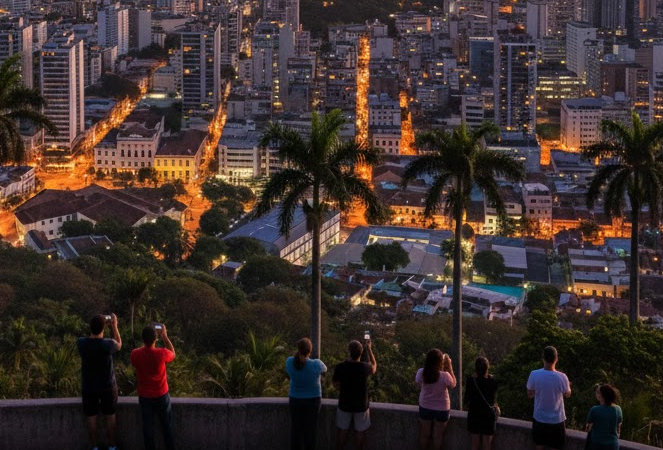
What defines a city in Brazil? This question seems simple, but the answer involves law, history, urban planning, and social dynamics. Unlike some countries where population size alone determines whether a place is considered a city, Brazil uses a unique combination of legal and administrative criteria. Understanding this definition helps clarify how Brazilian cities emerge, grow, and function within the country’s political structure.
In this article, we explore what truly defines a city in Brazil, going beyond numbers and looking at legal status, urban characteristics, and social relevance.
The legal definition of a city in Brazil
In Brazil, a city is not defined primarily by population size or density. Legally speaking, a city is the seat of a municipality. This definition is established by Brazilian law and dates back to administrative traditions that prioritize political organization over demographic criteria.
Every municipality in Brazil has:
- A city (the municipal seat)
- A mayor (prefeito)
- A city council (câmara municipal)
Once a municipality is created by state law, its headquarters automatically receives the status of “cidade”, regardless of how many people live there. This means that a city with 3,000 inhabitants has the same legal status as São Paulo or Rio de Janeiro.
Municipality, city, and urban area: key differences
To understand Brazilian cities, it is essential to distinguish between three concepts:
- Municipality (município): An administrative division with political autonomy.
- City (cidade): The urban headquarters of the municipality.
- Urban area: The built-up zone defined by local legislation.
In practice, the city corresponds to the main urban nucleus of the municipality, but not all urbanized areas in Brazil are cities. Districts can be urbanized and still not have city status if they are not municipal seats.
Population size is not a defining factor
One of the most surprising aspects of Brazilian cities is that population size is irrelevant from a legal perspective. Some cities have fewer than 2,000 residents, while others exceed 12 million, like São Paulo.
This approach contrasts with countries that classify cities based on:
- Minimum population thresholds
- Population density
- Economic activity levels
In Brazil, demographic data is important for planning and funding, but it does not determine whether a place is officially a city.
The role of state governments
Municipalities in Brazil are created by state laws, following constitutional rules. Each state defines specific criteria for creating new municipalities, which usually include:
- Minimum population
- Economic viability
- Urban infrastructure
- Local plebiscites
Once approved, the new municipality gains political autonomy, and its headquarters becomes a city. Therefore, while population matters during the creation process, it does not affect the city status afterward.
Urban characteristics that shape Brazilian cities
Although the legal definition is straightforward, Brazilian cities are also shaped by urban and social characteristics. Most cities share common features, such as:
- Defined urban perimeter
- Residential, commercial, and service areas
- Public infrastructure like schools, healthcare units, and transport
Cities like Campinas, Belo Horizonte, and Curitiba stand out for their complex urban systems, while smaller cities may have limited infrastructure but still fulfill administrative and social roles for their regions.
Economic and social functions of cities
Beyond legal status, a city in Brazil is often defined by its regional importance. Many cities function as hubs for:
- Trade and services
- Education and healthcare
- Employment opportunities
For example, Ribeirão Preto plays a major role in agribusiness and healthcare in the interior of São Paulo, while Santos is economically shaped by its port activities. These roles reinforce the perception of what makes a city “important,” even though the legal definition remains the same.
Historical roots of Brazilian cities
The concept of city in Brazil has strong historical roots. During the colonial period, cities emerged as administrative and religious centers, often around:
- Churches
- Fortifications
- Trade routes
The Portuguese administrative model influenced how settlements were elevated to city status, prioritizing political control rather than urban scale. This legacy remains visible today in the Brazilian municipal structure.
Cities, districts, and metropolitan regions
Brazil also recognizes other urban arrangements that influence how cities function:
- Districts: Subdivisions of municipalities without political autonomy.
- Metropolitan regions: Groups of municipalities with integrated urban dynamics.
Cities like São Paulo, Guarulhos, and Santo André are part of the same metropolitan region, sharing transportation systems, labor markets, and infrastructure. Even so, each city remains legally independent.
Urbanization and informal growth
Another factor that complicates the definition of a city in Brazil is informal urban growth. Many cities expand through:
- Informal settlements
- Irregular land occupation
- Peripheral neighborhoods
Despite these challenges, the legal status of the city remains unchanged. Urban planning policies attempt to integrate these areas, highlighting that a city is also a social and spatial process, not just an administrative label.
Why the Brazilian definition matters
Understanding what defines a city in Brazil is important for several reasons:
- It explains why small cities receive the same political status as large ones
- It clarifies how public policies and funding are distributed
- It helps interpret demographic and urban statistics correctly
This definition also reveals how Brazil values local political autonomy, even in sparsely populated regions.
Final thoughts on what defines a city in Brazil
In Brazil, a city is defined first and foremost by law, not by size, skyline, or economic power. Being the seat of a municipality is the decisive criterion. However, real cities are much more than legal entities. They are living spaces shaped by history, economy, culture, and people.
From small interior cities to massive urban centers like São Paulo and Rio de Janeiro, Brazilian cities reflect the country’s diversity and complexity. Understanding this definition provides a clearer view of how Brazil organizes its territory and urban life.