
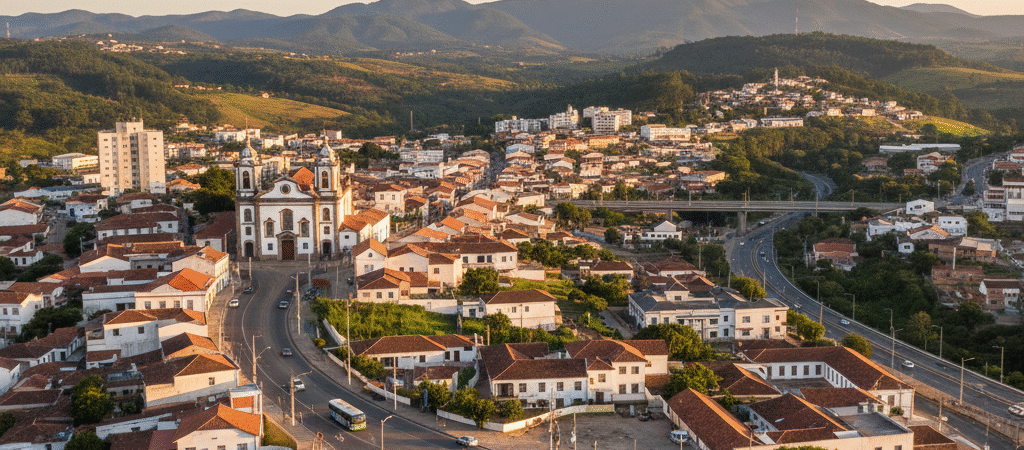
I visited Congonhas, a small city in Minas Gerais where art and faith blend perfectly in the stone sculptures of Aleijadinho and the peaceful hills that guard one of Brazil’s greatest baroque sanctuaries.
Congonhas: where devotion becomes art
When I arrived in Congonhas, I could already see the Sanctuary of Bom Jesus de Matosinhos rising above the city, its white walls and twin towers glowing against the blue sky. Even from a distance, it felt powerful. This wasn’t just another colonial church — it was a statement of faith carved in stone, standing proudly for more than two centuries.
The city itself is small and quiet, resting among the rolling hills of Minas Gerais. Everything seems to lead up to that sanctuary, as if the streets and the people naturally revolve around it. As I walked uphill toward the church, I could feel a growing sense of reverence. The air was lighter, the sound of bells echoed gently, and the scent of earth and incense mixed in the wind.
The masterpiece of Aleijadinho
At the top of the hill, the sanctuary reveals its true magnificence. Surrounding the church are twelve life-sized statues of the prophets, sculpted in soapstone by Antônio Francisco Lisboa — better known as Aleijadinho, Brazil’s greatest baroque artist. Each prophet stands with unique expression and detail, their faces both human and divine, their eyes filled with emotion.
Standing among them, I felt an almost sacred silence. It’s impossible not to be moved by the craftsmanship, especially knowing that Aleijadinho created these figures while struggling with a severe illness that deformed his hands. His suffering somehow deepened the humanity of his art. Every curve, every gesture seems to carry both pain and transcendence.
Inside the church, the altars are covered in gold, and the contrast between light and shadow brings the sculptures to life. The atmosphere is intense but intimate — it’s not about grandeur, but about spiritual presence.
The steps of the Passion
On the slope leading to the sanctuary, small chapels depict the Stations of the Cross, filled with terracotta sculptures that represent the Passion of Christ. These scenes are dramatic and deeply expressive. I stopped in front of each one, noticing the emotions on the figures’ faces — fear, sorrow, devotion. The craftsmanship is so vivid that you almost expect the statues to move.
Walking those steps feels like a pilgrimage, even if you’re not religious. It’s more than a spiritual journey; it’s an artistic one. Each chapel reveals a piece of Aleijadinho’s genius and of the faith that shaped the Brazilian soul during the colonial era.
The city beneath the sanctuary
Beyond the hill, Congonhas unfolds as a typical mining town: narrow streets, colorful houses, and friendly people who always have time for a chat. I stopped at a small bakery and had coffee with pão de queijo while watching life go by. There’s a softness in the rhythm of this city — as if time itself had learned to slow down out of respect for the sanctuary above.
In the city center, small museums and craft shops sell replicas of Aleijadinho’s prophets and other religious art made by local artisans. I spoke with one sculptor who said that carving soapstone runs in his family for generations. “It’s how we keep Aleijadinho’s spirit alive,” he told me.
Faith, art, and humanity
What impressed me most about Congonhas wasn’t only the beauty of its baroque art but the emotion it carries. The sanctuary isn’t just a monument; it’s a living testimony to what people can create when faith and creativity merge. Even those who aren’t believers can feel something powerful there — an energy that transcends religion.
At sunset, I returned to the top of the hill. The statues of the prophets were bathed in golden light, their shadows long and solemn. From up there, the view stretched across the valley, and the city below seemed wrapped in peace.
Conclusion: the mountain of silence and beauty
Congonhas may not be large or crowded, but it holds one of the most profound artistic treasures in Brazil. The Sanctuary of Bom Jesus de Matosinhos is more than a pilgrimage site — it’s a conversation between stone and spirit, between art and eternity.
As I left, the last bells of the day echoed through the hills. The prophets stood still, watching over the city as they have for centuries. And I understood that Congonhas isn’t just a place you visit; it’s a place that stays with you — a reminder that true beauty often speaks in silence.