
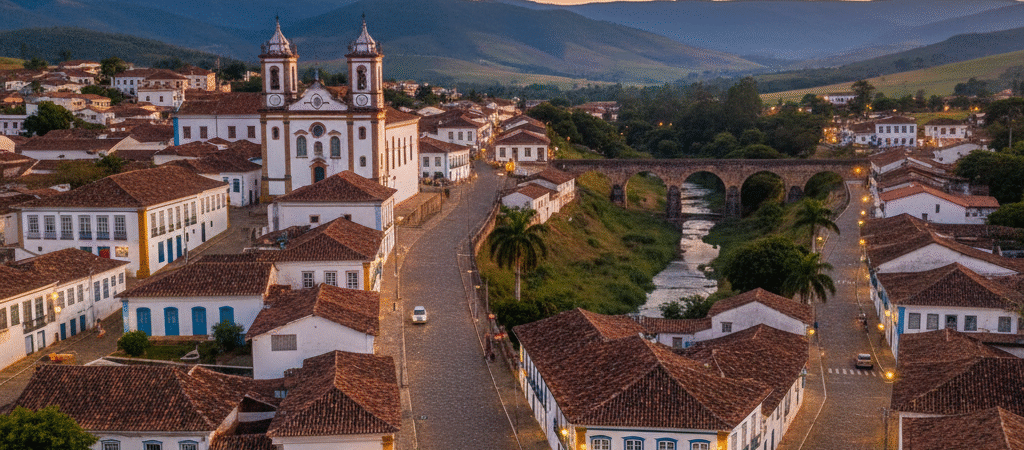
I explored Diamantina, a city of music, mountains, and history, where every stone street tells a story of gold, love, and art that still resonates through the voices of its people.
Diamantina: a city carved in stone and sound
When I first arrived in Diamantina, the air felt different — thinner, cooler, filled with the scent of dust and flowers. The town rests high in the mountains of Minas Gerais, surrounded by valleys that shimmer under the sun. Walking through its steep cobblestone streets, I could feel how time has slowed down here, allowing history to breathe freely.
Diamantina isn’t just beautiful; it’s alive with stories. Every balcony, every blue-and-white façade seems to whisper about explorers, poets, and musicians who once walked the same paths. It’s a city that holds its memories close, yet welcomes you as if you’ve always belonged.
Where gold turned into diamonds
Founded during Brazil’s mining boom, Diamantina grew when gold seekers discovered diamonds in the 18th century. The rush brought fortune, conflict, and art to the region, shaping the city’s identity. Standing in the old market square, I imagined the voices of traders and travelers, the clatter of horses, the sparkle of stones changing hands under candlelight.
Many of the grand colonial buildings still stand, with thick walls and wooden windows painted in bright colors. The architecture is elegant but modest — a reflection of a city that once glittered with wealth yet kept its soul grounded.
The sound of music and freedom
Diamantina has always been a city of music. It’s the birthplace of Juscelino Kubitschek, the president who built Brasília, but also of a rich musical tradition that defines its rhythm. On weekends, local groups gather to play serestas — romantic serenades performed under balconies. I joined a small crowd one night to listen, and it was one of those rare moments that feel eternal.
Guitars, flutes, and soft voices filled the streets with melodies about love and longing. The echoes bounced off the stone walls, and strangers sang together as if they’d known each other for years. In Diamantina, music isn’t entertainment — it’s a way of remembering, of belonging.
Walking through alleys and memories
Exploring Diamantina means getting lost on purpose. The narrow alleys twist and climb, opening into small squares where children play and women sell sweets from their doorways. The city invites you to slow down, to look closely at the details — the iron balconies, the carved doors, the light filtering through the mountains in the afternoon.
One of the most beautiful walks I took was toward the Cachoeira dos Cristais, a series of small waterfalls hidden just outside the city. The water was cold, pure, and surrounded by rocks that sparkled faintly in the sun — tiny traces of the minerals that gave this region its name.
A night at the old market
At sunset, the heart of Diamantina comes alive in the old market square. Locals and travelers gather to drink cachaça, listen to music, and talk. I tried pastel de angu, a local snack made with cornmeal, and watched as musicians tuned their instruments. The mood was light, almost magical.
As night fell, the church bells began to ring, and the entire town seemed to glow under the warm lights. It was easy to imagine the 18th century coming back to life — the same songs, the same laughter, the same hills illuminated by candles and stars.
Between mountains and dreams
The surrounding nature is another of Diamantina’s treasures. The Serra do Espinhaço unfolds in every direction, a vast landscape of rocky plateaus, waterfalls, and trails. From the top of a hill, I watched the city below, its white houses scattered among the mountains. The view was so serene that I sat in silence for a long time, listening only to the wind.
There’s something about Diamantina that makes you introspective. Maybe it’s the altitude, maybe the history, maybe the music that never stops playing somewhere in the distance. But being there makes you want to pause, to feel, to remember.
Conclusion: the melody of the mountains
Leaving Diamantina was harder than I expected. It’s a city that doesn’t try to impress you — it just stays with you. The sound of the serestas, the smell of wood and coffee, the laughter echoing through the alleys — all of it lingers like a song you can’t forget.
Diamantina taught me that beauty isn’t only about what you see, but what you hear and feel. It’s about how a city carved in stone can still sing — softly, endlessly, across the mountains of Minas Gerais.