
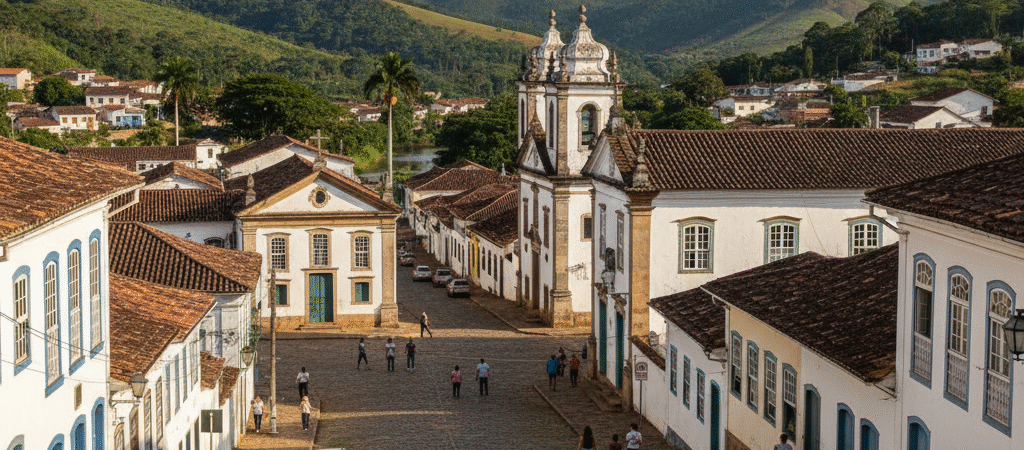
I visited Mariana, the first city of Minas Gerais, and found a peaceful place where gold, art, and time blend into a delicate balance between past and present.
Mariana: where Minas Gerais was born
The road from Ouro Preto to Mariana is short, but it feels like a journey through time. As I approached the city, the hills softened, the air felt calmer, and everything seemed to move at a slower rhythm. Mariana doesn’t have the grandeur of Ouro Preto or the liveliness of Tiradentes — its charm lies in its serenity. It’s a city that seems to know its own importance, yet wears it humbly.
When I walked into the main square, I was struck by the symmetry of the buildings, the elegance of the churches, and the sound of the fountain at the center. The square, called Praça Minas Gerais, looks like a perfect painting of colonial Brazil — with two baroque churches facing each other and the blue sky framing their towers.
The first city of Minas Gerais
Mariana holds the title of being the first city officially founded in Minas Gerais, back in 1711. It was also the seat of the first diocese in the region, which helped turn it into a spiritual and administrative center during the gold rush. You can still feel that sense of origin in the air — as if every stone carries the memory of beginnings.
The Cathedral of Nossa Senhora da Assunção, known as the Sé, is one of the most beautiful churches I’ve ever seen. Its façade is simple, but the interior reveals a masterpiece of gold-leaf decoration, delicate paintings, and sacred music. I had the chance to listen to an old organ concert there, and the deep, resonant sound filled the entire space like a living echo of history.
A walk through calm streets
What I liked most about Mariana was its peaceful rhythm. The cobblestone streets are wide and clean, the houses well preserved, painted in soft tones of white, yellow, and blue. Locals walk slowly, greeting each other, sitting on benches, or chatting in front of their doors. It’s a small city that feels more like a village, but with a soul much larger than its size.
I spent an afternoon exploring the neighborhoods around the historic center. Every corner offered a view worth stopping for — from the small bridges crossing narrow streams to the distant hills that shimmered in the late afternoon light. There’s something soothing about being in a place that doesn’t demand your attention but earns it naturally.
Gold, art, and stories underground
Mariana’s wealth once came from its mines, and some of them can still be visited today. I joined a guided tour through the Mina da Passagem, one of the oldest and largest gold mines in the region. To reach the tunnels, we descended on a small cart that rattled through the darkness until we arrived in a vast underground world carved by hand centuries ago.
Down there, the air was cool and heavy, and the sound of dripping water echoed through the walls. It was impossible not to imagine the lives of the miners who worked in such harsh conditions. At the same time, there was a strange beauty in that silence — a reminder of how much effort and sacrifice built the wealth that shaped Brazil’s history.
A city of art and reflection
Mariana is also home to artists and students who give it a quiet creative energy. I visited small galleries where local painters and sculptors displayed their work, often inspired by the city’s landscapes and churches. I noticed that, despite its historical weight, Mariana doesn’t feel stuck in the past — it continues to reinvent itself through art and everyday life.
Before sunset, I walked up to a lookout point and watched the city below. The church towers glowed golden in the fading light, and I could hear the bells ringing in the distance. It was a sound both joyful and melancholic, like a farewell and a blessing at the same time.
Conclusion: the gentle soul of Minas Gerais
Mariana might not be as famous as Ouro Preto or as busy as Tiradentes, but it has something none of the others quite possess — a calm dignity. It’s the cradle of Minas Gerais, a place where everything began, and where time seems to have learned the art of patience.
As I left, I felt grateful for the silence, the history, and the stillness that Mariana offered me. It reminded me that sometimes the most profound beauty isn’t found in noise or spectacle, but in quiet continuity — the kind that keeps a city’s soul alive through centuries.