
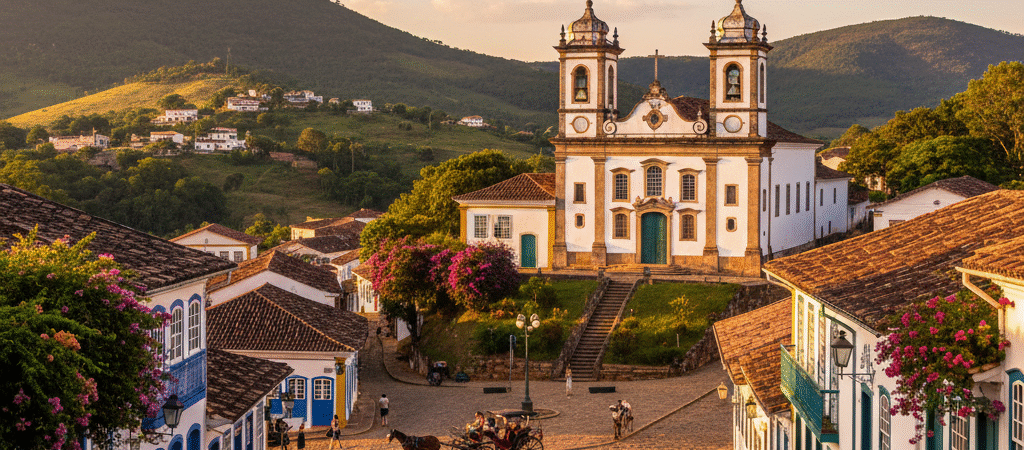
I spent a few days in Tiradentes, a small colonial town in Minas Gerais, and found one of the most peaceful and photogenic places in Brazil, where cobblestone streets, baroque churches, and homemade food create an atmosphere of timeless charm.
Tiradentes: where time slows down
When I arrived in Tiradentes, I felt like I had stepped into a postcard. The air smelled of wood smoke and coffee, and the quiet rhythm of the town made me instantly slow down. Unlike Ouro Preto, Tiradentes doesn’t rush to impress you with its grandeur — it seduces you with simplicity.
The mountains of Minas Gerais surround the town like a soft green blanket, and the colonial houses glow in warm shades of white, blue, and yellow. Everything seems perfectly preserved, yet alive. This balance between history and calmness is what makes Tiradentes unforgettable.
A town named after a hero
The town is named after Joaquim José da Silva Xavier, better known as Tiradentes, a revolutionary who fought for Brazil’s independence during the 18th century. He was executed for his ideals, but his legacy still echoes here. As I walked through the main square, I felt that sense of quiet pride — a reminder of how deeply history runs in the veins of Minas Gerais.
The statue of Tiradentes stands in front of the Matriz de Santo Antônio, one of the most beautiful baroque churches in Brazil. Inside, everything shines with gold leaf and intricate wooden carvings. The interior was designed by Aleijadinho, the same sculptor behind some of Ouro Preto’s masterpieces, and his touch is unmistakable.
Walking through cobblestone dreams
The best way to experience Tiradentes is to wander without a plan. The cobblestone streets are narrow and irregular, but every corner hides something worth seeing — an art gallery, a tiny chapel, a café serving homemade cakes. I spent hours just walking, taking photos, and greeting the locals, who always smiled back.
In the afternoon, I climbed up to the São José Fountain, built in the 18th century. The sound of running water mixed with birds and church bells created a kind of natural symphony. From there, I could see the rooftops of Tiradentes glowing under the sunset — it’s a view that stays with you.
The taste of Minas Gerais
If there’s something that truly defines Tiradentes, it’s the food. Every restaurant and street stand feels like an invitation to eat slowly, talk, and enjoy the moment. I tried a plate of feijão tropeiro with crispy pork, a glass of cachaça aged in oak, and finished with a slice of guava paste with cheese — the classic Romeu e Julieta combination.
At night, the town becomes even more magical. Small lanterns light up the streets, and the smell of grilled food and wood ovens fills the air. The restaurants often have live music — mostly soft bossa nova or traditional sertanejo — and it’s impossible not to relax after a day of exploring.
Art, craftsmanship, and authenticity
Tiradentes has a strong artistic spirit. Many local artisans create pottery, sculptures, and jewelry that reflect the traditions of Minas Gerais. I visited several small workshops where artists were carving soapstone or painting tiles. Unlike big tourist cities, everything here feels personal — every object has a story, every artist has time to talk.
The town also hosts cultural festivals throughout the year, like the Tiradentes Film Festival and the Gastronomy Festival. I wasn’t there during those events, but everyone told me the atmosphere becomes electric, with people coming from all over Brazil to celebrate food, art, and cinema.
Finding peace in the hills
One of my favorite moments in Tiradentes was a hike in the nearby Serra de São José. The trail wasn’t difficult, but it offered stunning views of the valley below. I sat for a while on a rock, just listening to the wind and watching the town from above. That silence — that sense of timelessness — is what makes Tiradentes special.
Back in town, I realized that the best way to experience this place is to do nothing in particular. Sit on a bench, drink coffee, watch people pass by. Time moves differently here, as if the clocks had all agreed to slow down a little.
Conclusion: a small town with a big soul
Tiradentes may be small, but it holds an immense soul. It’s not just a destination; it’s a mood, a rhythm, a reminder of how beautiful simplicity can be. The history is everywhere, but it doesn’t shout — it whispers through the bells, the hills, and the smiles of the people.
As I left, I felt calmer, lighter, almost nostalgic for a time I never lived. That’s what Tiradentes does to you: it reminds you that peace isn’t something you find; it’s something you allow yourself to feel.